
Investing
Types of mutual funds in India: a complete guide for investors
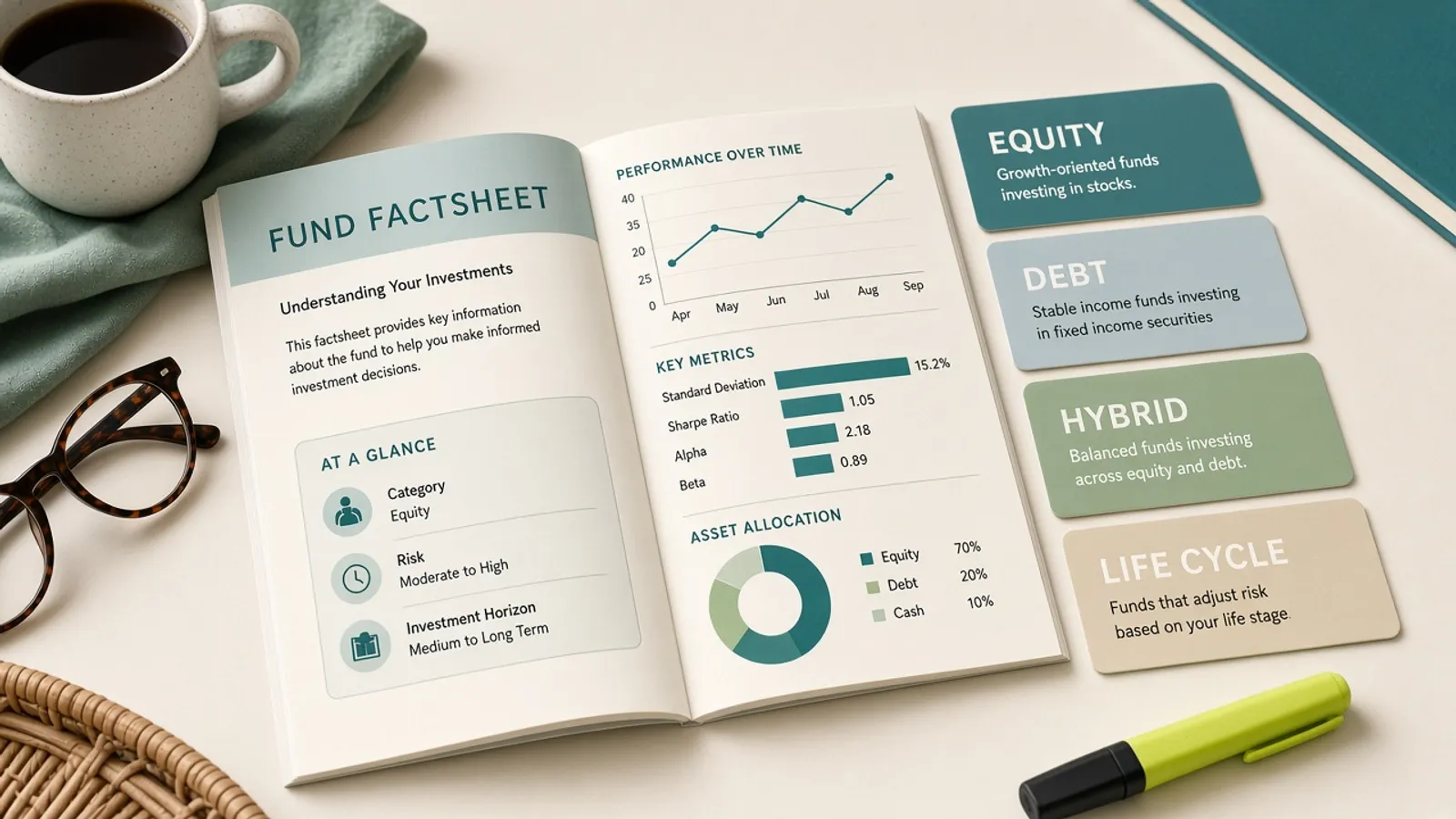
SEBI organises every scheme into defined groups. Learn the current equity, debt, hybrid, life cycle and other categories — and how each group commonly maps to a goal.
New investors meet a wall of scheme names. Large cap, flexi cap, gilt, arbitrage, balanced advantage. The labels sound interchangeable, and the list looks endless.
They are not interchangeable. SEBI organises every scheme into defined groups with fixed rules. Learn those groups, and the fund universe shrinks to a manageable size.
This guide covers the current types of mutual funds in India. It reflects SEBI's circular of 26 February 2026 and the Master Circular of 20 March 2026, which changed the framework meaningfully.
How SEBI classifies mutual funds
Before 2017, fund houses named schemes freely. Two funds with similar names could hold very different portfolios.
SEBI ended that with its October 2017 categorisation circular. Every scheme had to fit one defined category, each carrying rules on where the fund could invest.
The framework was then overhauled in February 2026. SEBI reshaped several categories, introduced new ones, and tightened the rules on overlap between schemes. The count of defined categories now runs to roughly forty.
Two principles still hold:
SEBI mutual fund categorisation principles
One scheme limit
A fund house may generally run one scheme per category, with defined exceptions.
Clear disclosure
The scheme documents must state the category clearly.
Our article on why the SID, SAI and KIM matter explains where to find that disclosure.
The main groups of mutual funds in India
The groups below cover almost every scheme a retail investor will meet. Each one answers a different need.
Equity funds
Equity funds invest mainly in company shares. They carry the highest growth potential and the widest swings in value.
SEBI defines eleven equity categories. The common ones work like this:
| Category | What it holds |
|---|---|
| Large cap | Top 100 companies by market capitalisation |
| Mid cap | Companies ranked 101 to 250 |
| Small cap | Companies ranked 251 onward |
| Flexi cap | Any market size, at the fund manager's discretion |
| Multi cap | A set minimum in large, mid and small caps each |
| ELSS | Tax-saving equity, with a three-year lock-in |
| Sectoral or thematic | One sector or theme, such as banking or technology |
Equity funds suit goals sitting more than seven years away. Shorter goals rarely give the portfolio time to recover from a fall.
The 2026 rules also cap portfolio overlap. Sectoral and thematic schemes must now limit similarity with other equity schemes to 50 per cent, with a phased realignment period.
Debt funds
Debt funds invest in bonds, government securities and other fixed-income instruments. They aim for steadier value rather than rapid growth.
SEBI defines sixteen debt categories, mostly separated by how long the underlying instruments run:
| Category | Typical instrument duration |
|---|---|
| Overnight | One business day |
| Liquid | Up to 91 days |
| Ultra short duration | 3 to 6 months |
| Short duration | 1 to 3 years |
| Corporate bond | Mainly high-rated corporate paper |
| Gilt | Government securities only |
The 2026 framework also added a sectoral debt category. Debt funds still carry risk, because interest rates move and issuers can default.
Hybrid funds
Hybrid funds hold a mix of equity and debt in one portfolio. The mix decides how the fund behaves.
| Category | Broad approach |
|---|---|
| Conservative hybrid | 10 to 25 per cent equity, rest in debt |
| Balanced hybrid | 40 to 60 per cent in each |
| Aggressive hybrid | 65 to 80 per cent equity, rest in debt |
| Balanced advantage | Shifts the equity share as markets move |
| Multi asset allocation | Spreads across at least three asset classes |
| Arbitrage | Uses price gaps between cash and futures markets |
| Equity savings | Combines equity, arbitrage and debt |
Fund houses may now offer both a balanced hybrid and an aggressive hybrid, which the earlier rules did not permit.
The marketing label does not decide tax treatment. The actual equity allocation does, as our capital gains guide explains.
Life cycle funds
This category is new, introduced by the February 2026 circular. A life cycle fund carries a fixed maturity year and a glide path.
- Maturities run in five-year steps: 5, 10, 15, 20, 25 and 30 years.
- The equity share reduces automatically as the maturity year approaches.
- The scheme can hold equity, debt, InvITs, and gold and silver ETFs.
- The name must include the maturity year, such as Life Cycle Fund 2045.
- A fund house may run up to six of them.
The design suits long-dated goals. Retirement and a child's education both fit the structure naturally. Our retirement planning page covers the broader approach.
Retirement and children's funds
SEBI first moved to discontinue this group, then reversed course. The February 2026 circular retired the solution-oriented category. The Master Circular of 20 March 2026 then allowed fund houses to continue these schemes, subject to conditions.
The conditions link the two categories together:
| If the fund house keeps | It cannot launch |
|---|---|
| A children's fund | The 20-year life cycle fund |
| A retirement fund | The 30-year life cycle fund |
| Both | The 20-year and 30-year life cycle funds |
If you hold one of these schemes, check your fund house's own communication. Some will continue the scheme, and others will merge it.
Other schemes: index funds, ETFs and fund of funds
This group tracks rather than selects.
- Index funds mirror an index such as the Nifty 50, without active stock picking.
- Exchange traded funds do the same, but trade on the exchange like a share.
- Fund of funds invest in other schemes rather than direct securities.
Passive schemes usually carry lower expense ratios than active ones. They also deliver the index return, including its falls. Our financial literacy section covers how costs compound over time.
What changed in 2026
The table below summarises the shift, because many older articles still describe the 2017 position.
| Area | Before 2026 | Now |
|---|---|---|
| Broad groups | Equity, debt, hybrid, solution-oriented, other | Equity, debt, hybrid, life cycle, other |
| Defined categories | 36 | Roughly 40 |
| Retirement and children's funds | A distinct category | Continued under conditions |
| Life cycle funds | Did not exist | New target-date category |
| Sectoral and thematic overlap | No cap | Capped at 50 per cent |
| Value and contra funds | One or the other | Both permitted |
A separate route also opened in April 2025. Specialised Investment Funds sit between mutual funds and portfolio management services, and carry a minimum investment of ten lakh rupees. Most retail investors will not encounter them.
Matching fund types to your goals
The category matters less than the fit. Start from the goal, then work back to the type.
| Goal horizon | Example goal | Categories commonly used |
|---|---|---|
| Under 1 year | Emergency reserve | Overnight, liquid |
| 1 to 3 years | Insurance premiums, a holiday | Ultra short, short duration |
| 3 to 7 years | Car, home down payment | Conservative or aggressive hybrid |
| Above 7 years | Retirement, child's education | Equity, index, life cycle |
These are general patterns, not recommendations. Your own choice depends on income stability, existing assets, tax position and comfort with volatility.
Our investment basics learning centre walks through the ideas behind goals, horizon and risk. The SIP calculator and Dream Retirement calculator handle the arithmetic, and the full set sits on our calculators page.
If you invest from Hyderabad or Secunderabad and want help organising this, our team sits in Secunderabad. Call or WhatsApp +91 99857 51771.
How to confirm a scheme's actual category
Scheme names mislead. The documents do not.
Check these four places before you invest:
Check Before You Invest
Monthly factsheet
Published by the fund house
Scheme category
Stated on the first page of the Key Information Memorandum
Latest portfolio disclosure
Shows actual holdings
Riskometer
Our riskometer guide explains in detail
A fund named for growth can still sit in a conservative category. Read the label, not the name.
Frequently asked questions
Four questions come up repeatedly when investors first study scheme categories.



Next step
Ready to Start Your Financial Journey?
Talk to our team — no pressure, just a conversation about your investment goals.
Mutual Fund investments are subject to market risks. Read all scheme-related documents carefully before investing.